September 27-30, 2026
LASER Center, Villebrumier, France
Artificial Intelligence, Software Engineering & Teaching:
Recipes for Success
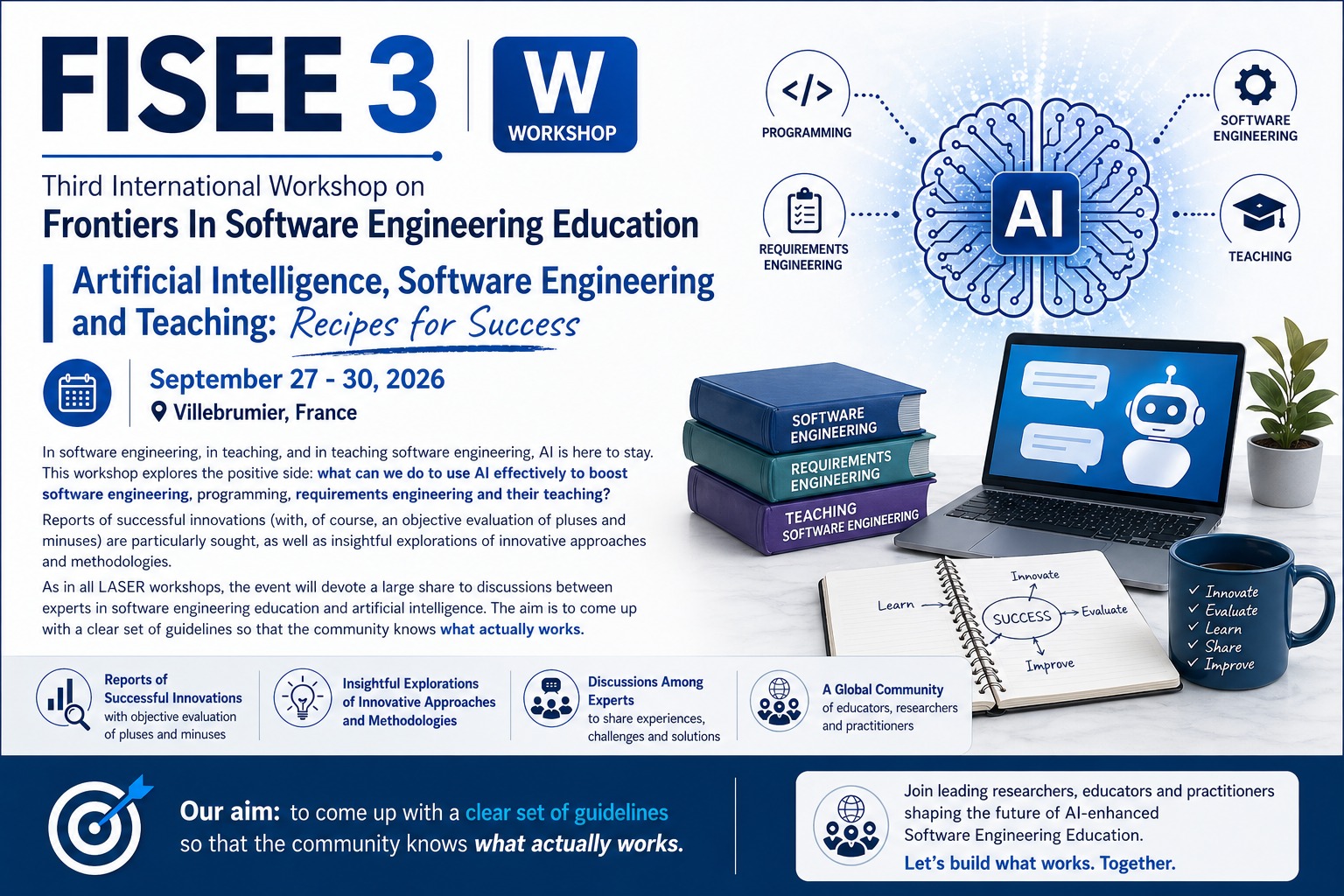
Following the success of FISEE 2019 and 2023 in Villebrumier, FISEE 2026 will again be devoted to advanced topics in software engineering education, with a particular focus on what occupies everyone’s thoughts and discussions right now: effective use of Artificial Intelligence.
In software engineering, in teaching, and in teaching software engineering, AI is here to stay. A lot of hand-wringing has been and is still taking place about how AI disrupts the field. This workshop goes beyond the hand-wringing to focus on the future and on the positive.
FISEE 2026 will explore the exciting side: what can we do to use AI effectively to boost software engineering, programming, requirements engineering and their teaching?
Reports of successful innovations (with, of course, an objective evaluation of pluses and minuses) are particularly sought, as well as insightful explorations of innovative approaches and methodologies. As in all LASER workshops, the event will devote a large share to discussions between experts in software engineering education and artificial intelligence. The aim is to come up with a clear set of guidelines so that the community knows what actually works.
Like other events at the LASER center, FISEE is not a traditional conference but a forum for discussion, followed by post-event publication in the LASER sub-series of Springer LNCS (Lecture Notes in Computer Science).
Submissions
- [PAST] 20 July 2026: deadline for submissions of workshop presentations.
- [PAST] 26 August 2026: notification.
- 1 December 2026 (to be confirmed): deadline for full paper submission for post-conference Springer LNCS (LASER sub-series) proceedings.
- To submit a contribution, use the following Easy Chair link for submissions.
Keynote speaker: [to be announced]
Organization
Program co-chairs: Jean-Michel Bruel (Univ. Toulouse), Sophie Ebersold (Univ. Toulouse), Armando Fox (UC Berkeley), Manuel Oriol (HEIG-VD, Switzerland)
Conference chair: Bertrand Meyer (Eiffel Software)
About the workshop
We will discuss in a friendly context how AI can best work for the teaching of software engineering.
The workshop is focused on discussion and exchanges.
The post-proceedings will be published as a volume of the Springer Lecture Notes in Computer Science.
Participation and submissions
All submissions will be reviewed for conformance to the aims of the workshop, but the actual refereeing process will apply to final contribution submitted after the workshop for publication in the LNCS proceedings. Authors should consult Springer’s authors’ guidelines and use their proceedings templates, either for LaTeX or for Word, for the preparation of their papers. Springer encourages authors to include their ORCIDs in their papers. In addition, the corresponding author of each paper, acting on behalf of all of the authors of that paper, must complete and sign a Consent-to-Publish form. The corresponding author signing the copyright form should match the corresponding author marked on the paper. Once the files have been sent to Springer, changes relating to the authorship of the papers cannot be made.
Submissions
Proposals
Proposals can be either full papers or extended abstracts (2 to 15 pages). All submissions will be reviewed for conformance to the aims of the workshop.
Post-proceedings
Final contributions must not only be conformant to the aims of the workshop, but also meet the following criteria:
Significance: The paper’s contributions are important with respect to topics addressed by computing education, and in particular software engineering education at any level.
Novelty: The paper presents new ideas and results and places them appropriately with respect to the state-of-the-art.
Evidence: The paper presents sufficient evidence supporting its claims, such as experimental results, statistical analyses, case studies, and anecdotes.
Clarity: The paper presents its contributions, methodology, and results clearly: i.e. adequate use of the English language, absence of major ambiguity, clearly readable figures and tables, and adherence to the LNCS format.
Papers will be reviewed by three PC members using a two rounds single-blind review process.
The first round may lead to either (1) reject the paper, (2) accept the paper (with minor modifications), or (3) request authors to provide a newer version of the paper (major revisions). In case of major revisions (case 3), authors are requested to provide a newer version of the paper along with a letter that explains how each concern has been addressed. Authors will have up to one month to submit the new (and final) version of the paper along the letter. The day after the letter and the newer version of the paper are submitted, the second round review is started. For the second round, reviewers will have 10 working days to review the latest submitted version. After that, the final decision is made based on reviewers’ scores. In case conflicts persist, the final decision is made by the chairs.
Topics
Topics of interest include, but are not limited to:
- Education in technology and technology for education
- New (and fearless) ideas on education
- Adjustments in teaching with AI: experience reports
- Models for class development
- How to design learning objectives and outcomes
- Labs and practical sessions: how to conduct them
- Curriculum Development
- Course Design
- Quality Course Assessment
- Long-life studies in education
- Empirical research in SE education
- Experiences in starting-up new educational systems
- Blended education
Important dates
Proposals (full papers or extended abstracts)
- [PAST] 20 July 2026: deadline for submission of papers and extended abstracts (and invitation requests)
- [PAST] 26 August 2026: notification of participation acceptance and position papers
- 5 September 2026: deadline for early bird registration
Workshop
- 27 September 2026 (Sunday evening): arrival day; welcome cocktail; concert
- 28 September 2026 (full day): workshop
- 29 September 2026 (full day): workshop
- 30 September (morning): workshop
- 30 September, 14: departure
Conference chair
Bertrand Meyer (Recognyze.ai, Eiffel Software)
Program chairs
- Jean Michel Bruel (University of Toulouse)
- Armando Fox (UC Berkeley)
- Sophie Ebersold (University of Toulouse)
- Manuel Oriol (HEIG-VD, Switzerland)
Organization chairs
- Marco Piccioni, PhD
PC Members
- Jean-Michel Bruel, University of Toulouse
- Alfredo Capozucca, University of Luxembourg
- Michael Caspersen, Aarhus University, Denmark
- Maximiliano Cristiá, National University of Rosario, Argentina
- Elisabetta Di Nitto, Politecnico di Milano
- Jin Song Dong, National University of Singapore
- Sophie Ebersold, University of Toulouse
- Armando Fox, University of California, Berkeley
- Zhoulai Fu, State University of New York, Korea
- Alfonso Fuggetta, Politecnico di Milano
- Orit Hazzan, Technion – Israel Institute of Technology
- Kan Jiang, National University of Singapore
- Rosemary Monahan, Maynooth University, Ireland
- Rumyana Neykova, Brunel University
- Manuel Oriol, HEIG-VD, Switzerland
- Meriem Ouederni, IRIT/INP Toulouse/ ENSEEIHT
- Cesare Pautasso, University of Lugano, Switzerland
- Andreas Rausch, Technische Universität Clausthal
- Nimisha Roy, Georgia Institute of Technology
- Min Zhang, East China Normal University
- Zheying Zhang, Tampere University, Finland
Venue
The workshop will be held in Villebrumier near Toulouse in Southwest France, a small conference center devoted to meetings on new technologies. Villebrumier is easily reachable from Toulouse International Airport (40 km) or Montauban train station (15 km, 4 hours from Paris via high-speed trains). Participants will be hosted (single or double room) on site or in a nearby hotel.
To ensure the quality of interactions, the number of participants is limited, on a first-come, first-served basis.
Program outline
The program is heavily oriented towards discussion and joint work. Each session is organized around a theme and structured as follows:
- General introduction by session chair (one of the PC chairs).
- Paper presentations
- Discussion led by the chair
| Sunday September 27 |
| 18-19:30 Special attraction: public concert (free for workshop participants) 8 PM Welcome cocktail |
| Monday Sept 28 | |
| Time | Activity |
| 9:00-10:30 | Session 1: can we teach software engineering without “suffering through” coding? — Chair: Armando Fox Papers: – John Keating: From Idea to App Without Coding: A Workshop Recipe for Teaching AI-Assisted Development to Non-Programmers (F) – Balbir Barn: Vibe Coding as Theory Building for Software Engineering: Implications for Software Engineering Education (F) – Kan Jiang: Reframing Software Engineering Education for Non-CS Learners: Reflections from an AI-Assisted Prototyping Course ( |
| 11:00-12:30 | Discussion on Session 1 |
| 12:30-14:00 | Lunch |
| 14:00-15:30 | Session 2: what software engineering activities can best benefit from AI? — Chair: Bertrand Meyer Papers: – Julia Kotovich, Ilgiz Mustafin and Manuel Oriol From Learning Objectives to Lecture Slides: An AI-Assisted Course Creation in Software Engineering Education (A) – José Antonio Parejo, Armando Fox and Pablo Fernández: Sparring Partners, Not Substitutes: AI Counterparts for Deliberate Practice in Software Engineering Education – Murat Karaorman, Tansel Ersavas and Ünsal Öztürk Design by Elicited Consent (A) |
| 16:00-18:00 | Discussion on Session 2 |
| 19:00-21:00 | Dinner |
| Tuesday Sept 29 | |
| Time | Activity |
| 9:00-10:30 | Session 3: Using AI conversational AI as sparring partners? — Chair: Manuel Oriol Papers: – Paolo Ciancarini: Conversational AI and Software Engineering Education – Geoffrey Challen: Nobody Knows How to Teach Conversational Programming: Today’s Most Powerful Computing Skill (A) – Van Eli Doris Ndili, Sophie Ebersold, Eric Lubat and Jean-Michel Bruel: A Labor Market-Aware Training Recommendation Digital Twin (A) |
| 11:00-12:30 | Discussion on Session 3 |
| 12:30-14:00 | Lunch |
| 14:00-15:30 | Paper Session 4: New pedagogical strategies — Chairs: Sophie Ebersold and Jean-Michel Bruel Papers: – John Keating: Reading Code Through Many Lenses: Teaching Software Quality Evaluation with Complementary Metrics (F) – Jordan Dino Fernandez and Angélica De Antonio Shared Memory, Specialized Agents: How Software Engineering Students Actually Use a Multi-Agent AI Workspace (F) – Muhammad Khalid and Manuel Oriol: Teaching Students to do Software Engineering of LLM-Based Systems (A) – Anastasia Kurdia: Integrating AI-Assisted Development into a Software Studio Course (A) |
| 16:00-18:00 | Discussion on Session 4 |
| 19:00-21:00 | Dinner |
| Wed. Sept 30 | Conclusion |
| Time | Activity |
| 9:00-10:30 | Working groups prepare conclusions |
| 11:00-12:30 | General discussion, next steps, preparation of manifesto |
| 12:30-14:00 | Lunch |
| 14:00 | Departure |
Workshop material
Initial papers will shortly be made available here. Participants are invited to read them in advance of the meeting.
Post-proceedings slides
Registration
Villebrumier events are in-person, fostering discussion and interaction.
The participants will be hosted at Villebrumier. As there are a limited number of rooms, single and double rooms will be assigned on a first-come, first-served basis. All costs in euros.
| Early bird: until Sept. 5) | Regular (after Sept. 5) | Attendance |
|---|---|---|
| Covers: Single or double room for 3 nights (Sunday to Wednesday), 3 breakfasts, 5 breaks, 3 lunches, 3 dinners, concert and welcome reception on Sunday | ||
| €625 | €695 | Author |
| €725 | €795 | Non-author |
| €245 | €275 | Accompanying person (subject to room availability, please contact the organizers early) |
| €275 | €275 | Per-day attendance inclusive of lunch, coffee breaks and dinner (half-day on Wednesday: €175). |
Transportation from Toulouse airport will be provided at a cost of EUR 20 in cash. Pick up will be on 27 September 2026 at 4:00 PM. Transportation back to Toulouse airport will be provided at a cost of EUR 20 in cash. The shuttle will leave from Villebrumier on 30 September at 2 PM. Transportation will also be provided to and from Montauban train station (TGV to Paris and Toulouse).